
.webp) Cecilia Lynch
Cecilia Lynch
7 Reasons Leadership Teams Misalign in Strategic Planning
.webp?width=30&name=cecilia_lynch_083(2).webp) Cecilia Lynch
Cecilia LynchLeadership teams misalign during strategic planning when false consensus, avoided trade-offs, and missing facilitation hide real disagreement.

You hired a strategic planning consultant. The engagement produced a polished plan, a set of priorities, and a confident leadership team. Six months later, the plan sits in a shared drive, untouched. The priorities haven't changed anyone's behavior. The team has drifted back to quarterly fires and reactive decisions.
This has a name. It's what happens when strategic planning consulting treats the plan as the finish line instead of the starting gun. And it's far more common than the consulting industry wants to admit. This guide breaks down the root causes behind consulting engagement failures and gives you a practical framework for making your next planning effort count.
The standard consulting engagement follows a predictable arc: discovery, analysis, a series of workshops, and a final deliverable. The consultant presents the plan, the team applauds, and the engagement ends. Everything that happens after the applause is left to you.
The gap between a completed plan and a functioning strategy is where consulting engagements break down. A 2026 benchmark study by OKRs Tool surveyed 180 strategy leaders at mid-sized companies and found that 86% of employees can't name their organization's top three priorities. Only 7% of leaders said their daily work ladders up to company strategy.
That's not a planning problem. That's what happens when the engagement ends at the plan, and nobody owns the translation into daily work. The consultant has moved on. Your team is back to fighting fires. The plan becomes a document rather than a discipline. Notice the pattern: the plan was fine. The engagement around it wasn't.
This is the core structural flaw in the traditional consulting model: it optimizes for the deliverable, not for the outcome. The engagement is scoped to produce a plan, not to make the plan operational. When you're paying for a document, you get a document. When the contract ends, so does the momentum.
Focused Momentum approaches this differently through its strategic plan implementation support, staying with leadership teams through the critical first year of execution. The plan isn't handed off and forgotten. It's built to be acted on, and the engagement is designed to ensure accountability, progress tracking, and course correction happen when they matter most.
One of the least discussed reasons consulting engagements fail is the facilitation itself. Many firms approach strategic planning as a data exercise: market analysis, financial modeling, competitive benchmarking. Those inputs matter. But the planning session is where alignment either happens or doesn't.
When a facilitator can't read the room, can't redirect a conversation that's gone sideways, or can't draw out the quiet skeptic in the corner, the resulting plan carries a hidden flaw. It reflects what the loudest voices said, not what the organization actually needs.
That flaw doesn't show up until six months later when the plan stalls and nobody can explain why.
Effective strategic planning facilitation requires someone who can hold space for disagreement, name the real tension in the room, and still move the group toward clarity. That's a skill set that goes beyond analytical rigor. It's the difference between a plan that has genuine buy-in and a plan that has signatures.
Consider what happens in the typical planning session. The CEO opens with a vision statement. The consultant presents market data. Department heads are asked for input. But the real conversations, the ones about competing priorities, turf, budget anxieties, and unspoken doubts about the direction, those happen during the subsequent team meetings afterward. A skilled facilitator brings those conversations into the room where they can be addressed directly.
At Focused Momentum, facilitation is designed to surface what leadership teams are actually thinking, not just what they're comfortable saying. That organizational alignment work is what makes the plan durable enough to survive contact with day-to-day operations.
The same 2026 benchmark study found that 83% of strategy leaders receive no automatic signal when execution drifts off course. They only find out at the next review, from a customer complaint, or when a metric finally moves in the wrong direction. By then, the drift has already hardened into a new status quo.
This is the execution cliff. The plan was sound. The priorities were clear. But nobody built the operating rhythm that keeps strategic focus alive between quarterly reviews.
Here's what's actually happening: strategy doesn't fail at the offsite. It decays in the weeks and months that follow, one deferred decision at a time.
The study also found that 60% of failing strategic priorities are never formally revised or killed. They just quietly disappear. No retrospective, no learning, no accountability. The priority limps to the end of the cycle, and by the next planning session, the team has silently agreed to pretend it never existed.
When a consulting engagement ends at the plan, the leadership team inherits not just the strategy but the entire burden of translating it into team-level work, tracking progress, and making the hard calls about what to cut when resources get tight. For a CEO or executive director who has never run a multi-year strategic execution before, that's an enormous lift with no support structure.
A well-designed consulting engagement builds execution discipline into the engagement itself: accountability structures, review cadences, and clear ownership of every strategic priority. Focused Momentum's methodology includes strategy alignment sessions that keep leadership teams connected to the plan long after the initial workshops end.
You can have a brilliant strategy and still fail if the board, the executive team, and the frontline leaders aren't aligned on what success looks like. Stakeholder misalignment often gets worse during consulting engagements that collect input from the top and present recommendations downward.
The result is a plan that reflects executive ambition over operational realities. Department heads nod during the presentation, then go back to running their teams the same way they always have. The strategy never becomes their strategy.
This pattern is especially common in nonprofits and mission-driven organizations, where board members, executive staff, and program leaders may have fundamentally different definitions of success. A fundraising-focused board might favor a growth strategy, while program directors focus on deepening impact with existing capacity. If those tensions aren't surfaced and addressed during the planning process, the plan papers over them. And papered-over tensions don't stay papered over for long.
Focused Momentum's Strategy Summit® process addresses this directly by engaging stakeholders across levels from the start, not as input sources but as co-creators of the strategic direction. When leaders at every level have shaped the plan, they own it. And ownership is what turns a plan into action.
This is also where many organizations discover that their misalignment isn't about strategy at all. It's about leadership transitions, unresolved governance questions, or competing definitions of what the organization is actually for. A good facilitator names those dynamics and creates the space to address them before the planning begins.
If you've been through a failed consulting engagement, you're not alone, and you're not wrong to be cautious about the next one. But the answer isn't to stop doing strategic planning entirely. The answer is to choose an engagement that's built for what actually makes plans fail.
Before you hire your next consultant, ask these questions: Does the engagement include execution support, or does it end at the plan? Will the facilitator work with your team to build strategic thinking capacity, or just deliver recommendations? Is there a clear structure for how accountability and progress tracking will work after the plan is approved?
Ask about the facilitator's experience with organizations like yours. If you're a nonprofit executive director, your planning needs differ from those of a manufacturing CEO. The facilitation approach should reflect that. Ask to see case studies or client stories from organizations of similar size and complexity.
Focused Momentum's approach to strategic planning consulting is built on over 25 years of working with leadership teams in mid-sized companies and nonprofits. The firm's proven methodology connects planning to execution, facilitation to alignment, and strategy to the daily decisions that determine whether the plan survives its first year.
The pattern behind failed consulting engagements is consistent: too much emphasis on the plan, not enough on the people and systems that bring it to life. If your last strategic plan stalled after the consultant left, the plan itself probably wasn't the problem. The engagement was.
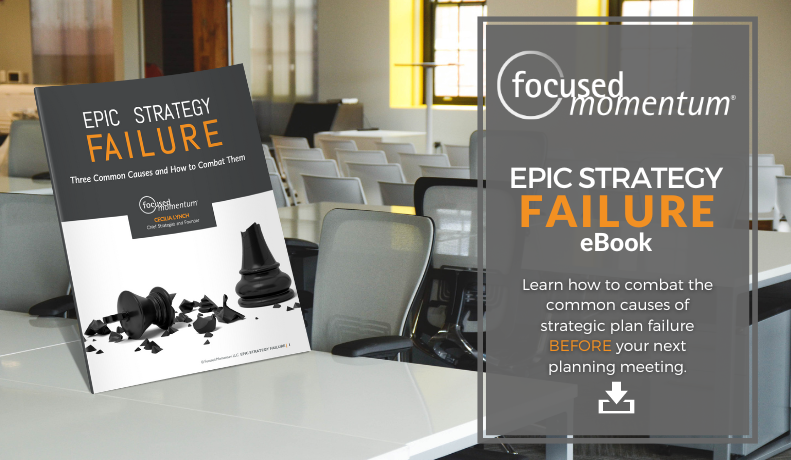
If you want to go deeper, my eBook, Epic Strategy Failure, breaks down the most common patterns behind strategic planning failures and gives you a practical framework for diagnosing what went wrong and what to do differently. It's built from real cases and designed for leaders who've already been through a failed engagement and want to make sure the next one produces results that last.
And if you're ready to explore what a strategic planning engagement could look like for your organization, Focused Momentum's client stories show how other leadership teams have turned planning into measurable, sustained progress.

Leadership teams misalign during strategic planning when false consensus, avoided trade-offs, and missing facilitation hide real disagreement.

Corporate strategy asks what business to be in. Business unit strategy asks how to win within it. Confusing them is why most planning stalls.

Competition is real, so even the best strategic planning efforts can fail when key assumptions change or when an innovation radically shifts your...
