
Strategic Thinking
The Essential Guide for:- Business Leaders
- Entrepreneurs
- Nonprofit Executives
Master the cognitive frameworks that separate leaders from managers to transform how you approach every business decision.
Free Download
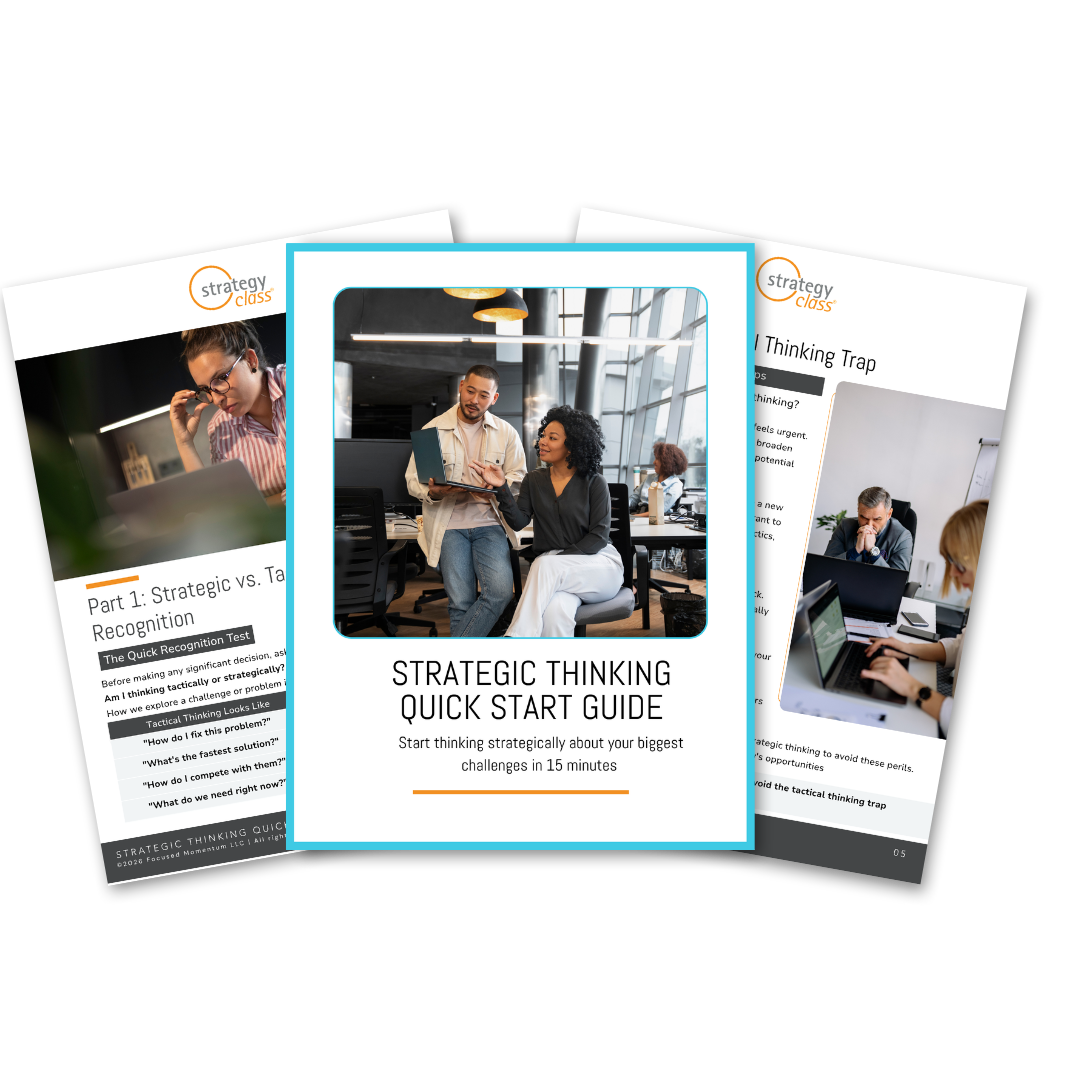
Strategic Thinking Quick Start Guide
Begin developing these essential capabilities immediately!

Why Most Leaders Think They're Being Strategic
(When They're Actually Just Busy)
Most leaders believe they're thinking strategically when they're actually just solving problems faster. The difference costs companies millions, stalls careers, and creates endless firefighting cycles—but it's entirely learnable.
The hard truth: Only 28% of executives rate their strategic decisions as high-quality, while 60% report that bad decisions are about as frequent as good ones (McKinsey/Harvard Business School, 2025). Meanwhile, organizations implementing strategic thinking capabilities improve operational performance by 30-50% (McKinsey, 2020).
Strategic thinking isn't about being smarter or working harder—it's about developing specific cognitive capabilities that enable you to navigate complexity, anticipate change, and create sustainable advantage regardless of your role or industry.
This comprehensive guide provides the same strategic thinking frameworks used by Fortune 500 companies, adapted for leaders at every level—from startup founders to nonprofit executives to small business owners building sustainable competitive advantages.
Table of Contents
What is Strategic Thinking?
Strategic thinking is the ability to focus on ultimate goals and work backward to align actions. Unlike tactical problem-solving, which addresses immediate issues, strategic thinking involves analyzing the broader context, identifying ideal positions or roles, and developing responses that create long-term advantages.
The Core Components
At its essence, strategic thinking encompasses:
- Orienting decisions with the end in mind rather than reacting to immediate pressures
- Considering long-term impacts and consequences across multiple time horizons
- Analyzing complex systems and interrelationships to find leverage points
- Identifying opportunities and threats in the broader environment before they become obvious
- Aligning actions with overarching goals and vision even during daily firefighting
Strategic thinking has evolved from an exclusive executive skill to an essential capability required at all organizational levels. In today's complex and rapidly changing environment, the ability to think strategically has become crucial for navigating an increasingly interconnected world.
Key Insight
Strategic thinking is a cognitive skill that can be developed through deliberate practice, rather than being an innate talent reserved for executives.
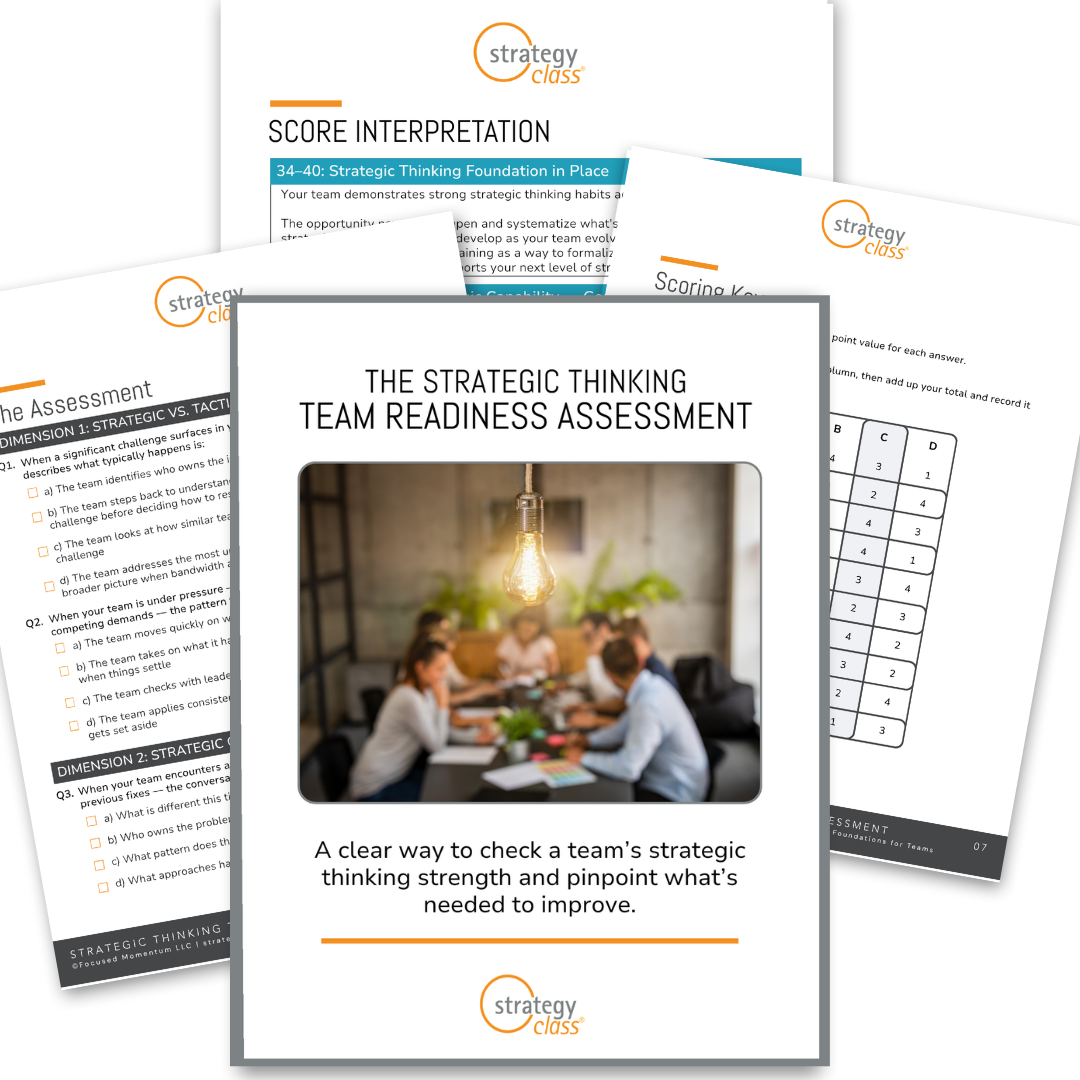
Strategic Thinking Team Readiness Assessment
Evaluate their readiness and what to do to close gaps.
Strategic Thinking vs. Strategic Planning: A Critical Distinction
Many people confuse strategic thinking with strategic planning, but they serve fundamentally different purposes.
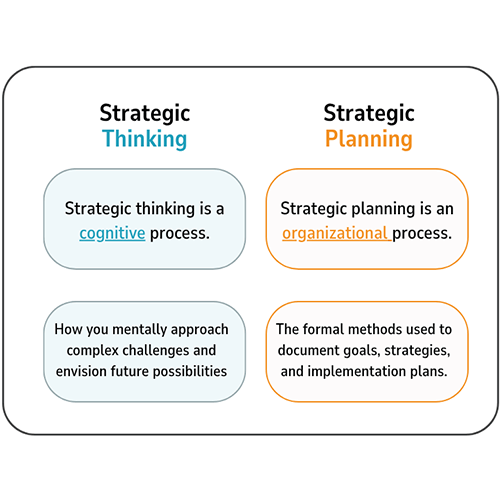
Strategic thinking provides the foundation that makes strategic planning effective.
Without its capabilities, even the most sophisticated planning processes produce mediocre results.
Download our Free
Strategic Thinking Quick Start Guide
Begin developing these essential capabilities immediately!

Decision-Making Quality Crisis
- Critical Finding: Only 28% of executives rate their strategic decisions as high-quality, while 60% report that bad decisions are as frequent as good ones (McKinsey/Harvard Business School, 2025).
This decision-making crisis creates competitive opportunities for leaders who can think more strategically about complex challenges.
Performance Improvements Are Dramatic
Organizations developing strategic thinking capabilities see transformational results:
- 30-50% operational performance improvement when implementing agile transformations that require strategic thinking (McKinsey, 2020)
- 40% reduction in time to market through strategic approaches (McKinsey, 2020)
- Only 14% of leaders report their organizations has truely adopted agile operating models across the board (McKinsey, 2023)
Innovation and Growth Multipliers
Strategic thinking directly drives innovation success:
- C- Companies actively promoting innovation culture are 3.5 times more likely to outperform peers (McKinsey, 2022)
- Organizations with strong innovation cultures are 60% more likely to be innovation leaders (BCG, 2024)
- These same organizations achieve 30% higher enterprise value growth (Viima Research, 2023)
The Leadership Connection
The impact on team performance is equally compelling:
-
70% of team engagement is determined solely by the manager (Gallup, 2025)
-
Yet only 44% of managers receive formal training (Gallop, 2025)
-
Managers trained in strategic thinking practices see 20-28% performance improvements (Gallup, 2025)
-
Their teams experience up to 18% higher engagement (Gallup, 2025)
BOTTOM LINE: Strategic thinking capabilities create measurable competitive advantages across decision-making quality, operational performance, innovation success, and leadership effectiveness.
The Complexity Challenge "Why"
Modern professionals face unprecedented information complexity that overwhelms traditional decision-making approaches:
Information overload: 40% of executives and 30% of managers report feeling highly burdened by information (Harvard Business Review, 2023). And the consequence is direct: employees who struggle with information volume are 3.5 times less likely to innovate or think strategically (Microsoft Work Trend Index, 2023).
Exponential change: ChatGPT reached 100 million users in 2 months vs. Facebook's 4.5 years
System interconnectedness: Decisions cascade through complex global systems in unpredictable ways
Strategic thinkers who can process this complexity deliver measurable results. As research shows, companies with strong innovation cultures achieve 60% higher likelihood of becoming innovation leaders and 30% higher enterprise value growth (BCG, 2024; Viima Research, 2023).
The Pattern Recognition Advantage "Why"
The speed of change now requires strategic thinking skills to recognize patterns and anticipate disruptions before they become obvious.
Real-World Example: When 73% of global consumers indicated willingness to change consumption habits for environmental reasons (Nielsen, 2022), strategic thinkers recognized this wasn't just a marketing challenge but a signal requiring fundamental changes in supply chains, product development, and business models.
Companies like Patagonia succeeded because leaders could think strategically about connections between environmental responsibility, brand loyalty, and long-term profitability—while competitors treated it as a PR issue.
Adaptive Decision-Making Under Uncertainty "Why"
Strategic thinking enables effective decisions with incomplete information while remaining adaptable to changing circumstances.
Consider this: Global subscription economy revenue is forecast to approach $1 trillion by 2028 — nearly doubling from $593 billion in 2024 (Juniper Research, 2024). This shift from ownership to access models rewarded organizations whose leaders could see the structural change coming and penalized those who couldn't adapt their mental models fast enough.
BOTTOM LINE: Strategic Thinking Is No Longer Optional. As volatility and uncertainty have become the norm, strategic thinking has evolved from a useful business skill to an essential cognitive capability. Whether you're leading a Fortune 500 company, a growing startup, a nonprofit organization, or your own small business, these cognitive capabilities now determine leadership effectiveness.
Strategic vs. Tactical Thinking:
The Critical Distinction That Changes Everything
Understanding the difference between strategic and tactical thinking is fundamental to developing strategic capabilities. Most professionals excel at tactical thinking but struggle with strategic approaches—and the distinction matters more than most realize.
The Strategic Advantage: By the Numbers
70%
70% of team engagement depends on managers (Gallup, 2025)
Strategic leaders create engagement by connecting daily work to meaningful long-term goals.
30-50%
30-50% operational performance improvement from strategic transformations (McKinsey, 2020)
Systems thinking enables breakthrough results impossible through tactical optimization alone.
60%
60% more likely to be innovation leaders with a strategic culture (BCG, 2024)
Strategic thinking capabilities drive pattern recognition and opportunity identification, fueling innovation.
28%
28% of executives rate their strategic decisions as high-quality (McKinsey, 2025)
Most leaders lack systematic strategic thinking frameworks, which can create a competitive advantage for those who develop and use these frameworks.
Understanding the difference between strategic and tactical thinking is one thing; recognizing it in your own decision-making is another.
The Tactical Thinking Trap
Why Smart Leaders Stay Stuck
Understanding the difference between strategic and tactical thinking is the first step. The harder step is recognizing when tactical thinking has taken over because it never feels like a trap. It feels like competence.
The skills that make tactical thinkers excellent in the short run are the same skills that work against them in the long run. They're fast, responsive, and reliable. And because they're so focused on solving what's in front of them, they never stop to ask whether the problems in front of them are the right ones to be solving.
The trap is invisible because it looks like work. It looks like competence. It looks like doing your job.
There are four versions of this trap. Most leaders have a dominant pattern they default to under pressure.
Trap 1: Urgency Addiction
What it looks like: Every hour is claimed. Every problem gets an immediate response. The calendar has no breathing room because white space feels like waste.
Urgency Addiction is built on a genuine strength, responsiveness. But urgency is a feeling, not a fact. Most of what lands on an urgent leader's plate isn't actually urgent. It feels urgent. It arrived with pressure attached.
The real cost isn't wasted time. It's the strategic thinking that never happens because there's no room for it. Strategic thinking requires the space to sit with ambiguity. For the leader addicted to urgency, that space never gets created, and the problems that strategic thinking would have caught early keep compounding.
The signal: Your calendar has no breathing room. When you try to think about where things are headed, something pulls you away. You can't remember the last time you had two uninterrupted hours to think, not react, not execute, just think.
Trap 2: Competitor Mimicry
What it looks like: A competitor makes a move. You respond. Their decisions are writing your strategy.
Competitor Mimicry is built on market awareness, another real strength. Watching what others do feels strategic. But following a competitor's lead means they're defining your direction for you. Every move you mirror takes you further from what made you worth choosing in the first place.
The independent business that lowers prices to match a chain is now competing on the one dimension where the chain will always win. The team that copies another department's approach ignores the context that makes their situation different.
The signal: A significant part of your decision-making time is spent watching what competitors or peers are doing. When someone asks why you made a decision, the answer often starts with something someone else did first.
Trap 3: Customer Request Fulfillment
What it looks like: You listen carefully, deliver what's asked for, and the problem doesn't go away. The same underlying issues surface in different forms.
Customer Request Fulfillment is built on listening, a genuinely valuable approach. The challenge is that people describe what they want rather than what they need. Beneath every stated problem is a real one. Without asking whether the two match, you can work very hard in the wrong direction.
The manager who gives their team what they ask for but never asks what they would never think to ask for. The product team that builds every requested feature but never asks what customers are actually trying to accomplish.
If you've worked hard on a problem and it won't stay solved, you may be solving the right answer to the wrong question.
The signal: You're good at delivering what people ask for, but the results don't always match the effort you put in. The same underlying issue resurfaces in different forms.
Trap 4: Problem-Focused Identity
What it looks like: Fixing things is where you feel most useful. Strategic planning feels less satisfying than solving what's right in front of you. Problems get solved, only to come back.
Problem-Focused Identity is the deepest of the four traps because it's not just a thinking pattern; it's a self-concept. Leaders who land here have been rewarded for solving problems their entire careers. So when a challenge arrives, they solve it. That's who they are.
The problem is that some challenges aren't meant to be solved; they're meant to be reframed. And a leader whose identity is built around fixing things has a hard time stopping long enough to ask whether the problem in front of them is the right problem at all.
The signal: You feel most capable when there's a crisis to solve. Preventive work and long-term thinking feel less satisfying than fixing what's in front of you. The same categories of problems keep coming back.
A Trap Is a Strength, Taken Too Far
Here's what all four traps have in common: they're built on something real.
Urgency Addiction is built on responsiveness. Competitor Mimicry is built on market awareness. Customer Request Fulfillment is built on listening. Problem-Focused Identity is built on execution.
These are genuine strengths. The trap isn't the strength; it's what happens when the strength runs on autopilot, applied reflexively, without asking whether the moment calls for it.
The responsive leader who can't turn off responsiveness misses the opportunity to eliminate most of what they're responding to. The listener who never questions what they're hearing solves the wrong problem brilliantly. The excellent problem-solver who never asks whether they have the right problem never quite does.
The goal isn't to stop being responsive, aware, attentive, or capable. The goal is to notice when those strengths work for you and when they work against you.
Which Trap Is Yours?
Most leaders have a dominant pattern. The one they return to under pressure. Some recognize themselves in two of these. A few find themselves in all four at different times.
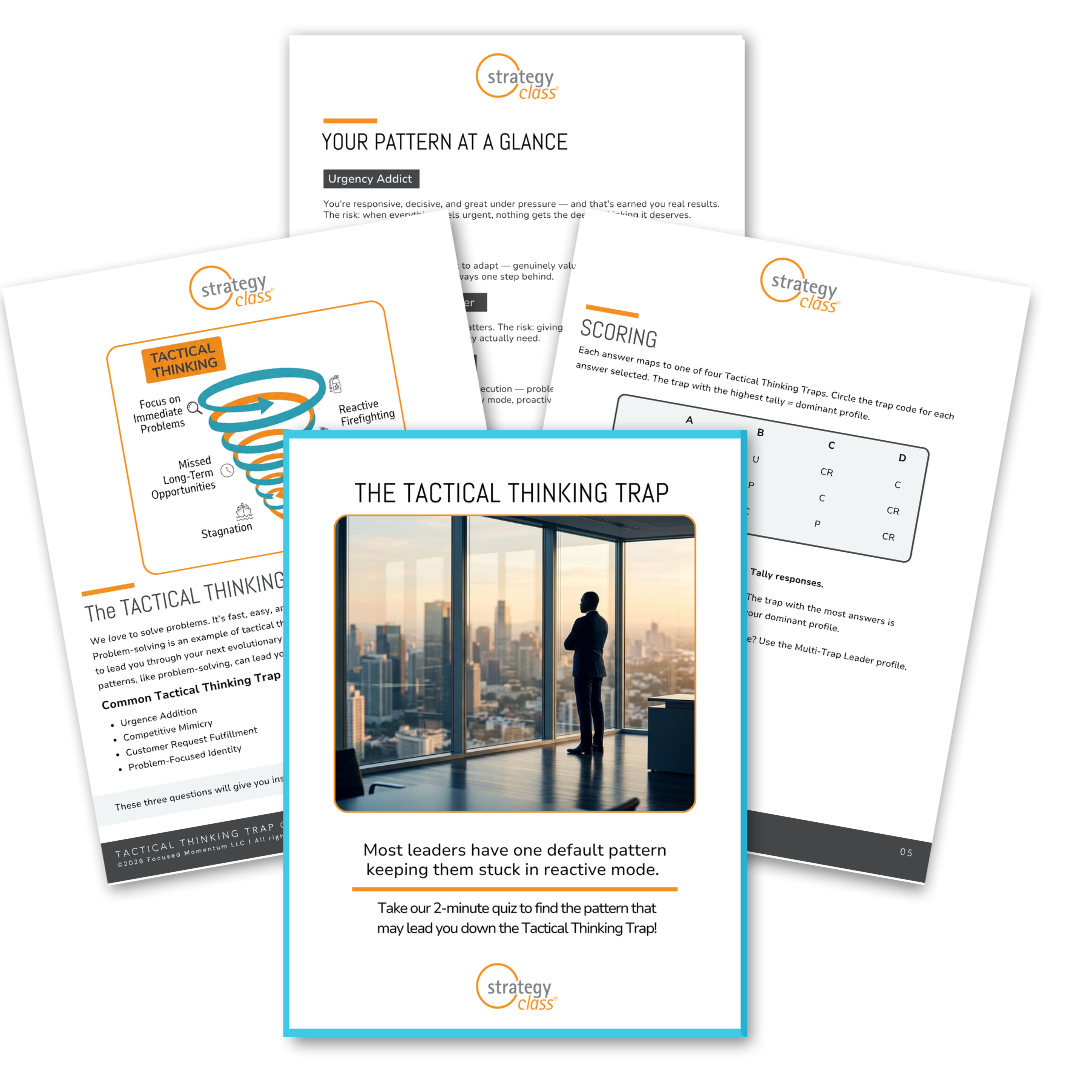
Download our Free
Tactical Thinking Trap Quiz
Find out which Tactical Thinking Trap is running your decisions.

Three Strategic Thinking Patterns
Strategic thinking manifests through three distinct patterns that you can observe and practice. Each pattern represents a different way strategic thinkers approach challenges, and mastering these patterns transforms how you lead, decide, and create value.
Let's examine each pattern through real-world examples that demonstrate the dramatic difference between tactical and strategic approaches.
PATTERN 1: Reframe the Problem
The easiest way to understand the distinction in this pattern is in how we frame questions when exploring a challenge.
Tactical Thinking Approach:
"What should I do about this problem right now?"
Strategic Thinking Approach:
"Where do I want to be in 3 years, and what would someone in that position do today?"
Let's look at a real-world example.
Real-World Example: Neighborhood Restaurant vs. Chain Competition
A family-owned neighborhood restaurant learns that a national chain is opening nearby. This restaurant now faces competition it has never experienced before.
Tactical Thinking Response:
- Match competitor's prices with promotional discounts
- Extend hours to capture more meal periods
- Add menu items that the competitor offers
- Increase advertising spending to maintain visibility
Result: Enters a price war that erodes profitability while becoming more similar to the competitor.
Strategic Thinking Response:
- Analyze what the chain can't or won't do
- Focus on becoming the "neighborhood gathering place"
- Develop relationships with local suppliers for unique menu items
- Create community events and local partnerships
Result: Differentiates through community connection and unique value that the chain cannot replicate.
Applying Strategic Thinking to Competition
Tactical thinking competed on the competitor's terms; strategic thinking competed where the competitor couldn't follow.
The restaurant owner envisioned being the neighborhood's gathering place in three years, then worked backward to build that positioning today through local partnerships and community events the chain could never replicate.
PATTERN 2: Reveal and Link Systems
The easiest way to understand the distinction in this pattern is in how we frame questions when exploring a challenge.
Tactical Thinking Approach:
"How do I fix this specific issue?"
Strategic Thinking Approach:
"What system created this issue, and how do I change the system?"
A real-world example will help clarify the distinction in these patterns.
Real-World Example: High Team Turnover on a Customer Success Team
Sarah led a 12-person customer success team at a growing software company. For 18 months, she fought 35% annual turnover. Her strongest people, the ones customers asked for by name, kept leaving after six to nine months.
Exit interviews said the same thing every time: "I'm looking for a growth opportunity."
Sarah listened. She responded.
Tactical Thinking Response:
- Raised compensation for top performers
- Improved benefits and added flexible work options
- Sped up hiring to reduce disruption between departures
- Added recognition programs to increase team morale
- Built a more structured onboarding process
Result:
Eighteen months. Five interventions. Turnover barely moved. The same people kept leaving for the same reason.
Strategic Thinking Response:
Sarah stopped fixing and started questioning. She looked at the system producing the problem rather than the problem itself.
When she mapped the full picture, who was leaving, when, and what they were leaving for, the real issue appeared. The role had no growth trajectory. High performers mastered it in six to nine months and had nowhere to go. They weren't leaving because they were unhappy. They were leaving because they were done.
She had been solving a retention problem. The real problem was role design.
Her strategic response addressed the system:
- Redesigned the role into three defined advancement tiers with clear criteria for progression
- Built specialist tracks for different development paths — technical depth, strategic accounts, and team enablement
- Created internal mobility partnerships so that movement into other departments became a planned outcome, not a loss
- Shifted her measure of success from how few people left to how many people advanced
Result:
-
Annual turnover dropped from 35% to 12%
-
Customer satisfaction scores increased 40% as account relationships stabilized
-
Recruiting costs dropped 60%
-
Two other departments adopted versions of the model within a year
-
Sarah was promoted to Director of Customer Success within 14 months of launch
Applying Strategic Thinking to Human Resource Challenges
Tactical thinking treated each departure as a staffing problem to solve. Strategic thinking revealed a structural condition to change.
Sarah's five tactical interventions addressed how people felt about the role. Her strategic response addressed what the role actually was. The first approach produced five rounds of effort and minimal results. The second produced a system that made the problem structurally unnecessary.
The people weren't the problem. The design was.
PATTERN 3: Test Creative Solutions
The easiest way to understand this pattern is in how strategic and tactical thinkers approach building a response once they understand the problem.
Tactical Thinking Approach:
"What can I come up with to solve this?"
Strategic Thinking Approach:
"Who has already solved something like this — and what can I adapt for my context?"
Strategic thinkers do not invent responses from scratch. They look across industries, sectors, and contexts for proven approaches to similar challenges, then deliberately adapt them to their specific situation. The creative part comes from the adaptation — not from starting with a blank page.
Real-World Example: Neighborhood Restaurant vs. Chain Competition
Once Tim understood that competing with the national chain on price, hours, or menu was a losing strategy, he faced a different challenge: how to build a response that a competitor with unlimited resources cannot replicate?
He did not try to invent one.
Tactical Thinking Response:
- Brainstorm new promotions or menu changes
- Work from what competitors are doing and try to do it differently
- Build a response based on what has worked before
Result: A reactive cycle built on internal ideas and competitor benchmarking — producing responses the chain has already anticipated and can outspend.
Strategic Thinking Response:
Tim looked outside the restaurant industry entirely. He called his produce supplier, the baker he had worked with for five years, and a representative from the small regional wineries he had been featuring quietly on his menu for years.
He was not looking for favors. He had started to see proven models that other businesses were already using, local supplier features, community membership programs, and private event hosting, and he adapted each one to his specific relationships, his neighborhood, and his customer base.
- Local Supplier evenings: Adapted from the farm-to-table movement and used in food-forward urban restaurants — modified for his neighborhood and his existing supplier relationships
- Membership program: A model used in independent bookstores and specialty retailers to formalize customer loyalty — adapted for a restaurant context without a points app or technology investment
- Private dinners for local businesses: An event-hosting model common in urban venues, adapted to fill his back section on nights it would otherwise be empty
None of these were invented. All of them were adapted.
Result:
-
Local Supplier evenings sold out for three consecutive months; a local food writer covered the third event, driving a measurable increase in new reservations
-
The membership program grew by referral, with members referring members, with the sense of belonging becoming something customers were glad to pay a modest amount to formalize
-
Two corporate accounts from a neighboring office building signed on, referred by an existing client
-
Margin improvement of 25%, not from higher prices, but from a customer base that was no longer making direct price comparisons with the chain
Applying Strategic Thinking to Competition
Tactical thinking asks what you can build. Strategic thinking asks what already works — and what you can make your own.
Tim did not create local supplier partnerships, membership models, or private event programming. Those models existed and worked in other contexts. His strategic move was to find them, assess which ones fit his situation, and adapt them in ways the chain could not follow — because none of those approaches were standardizable across hundreds of locations.
The creative solution was not invented. It was found, tested, and made specific.
Ready to develop strategic thinking capabilities systematically?
Download the Strategic Thinking Quick Start Guide and get started today!
Five Core Skills
That Can Separate Strategic Leaders from Managers
Developing strategic thinking requires mastering several interconnected cognitive capabilities. These skills work together to enhance your ability to navigate complex challenges and identify breakthrough opportunities.
Research Validation: These capabilities create a significant competitive advantage, yet McKinsey's 2023 State of Organizations research found that only 14% of leaders report their organization has truly adopted agile operating models across the board (McKinsey, 2023). Meanwhile, companies promoting an innovation culture are 3.5 times more likely to outperform their peers (McKinsey, 2022). The gap between what's possible and what organizations have actually built is where the opportunity lives..
You've seen how strategic thinking manifests through three distinct patterns—future-back thinking, systems view, and opportunity recognition. But what cognitive capabilities enable these patterns?
Five Core Strategic Thinking Skills
Strategic thinking isn't a single skill; it's an interconnected set of five core capabilities that work together to enhance your ability to navigate complex challenges and identify breakthrough opportunities. These aren't abstract competencies—they're practical skills you can develop systematically through deliberate practice.
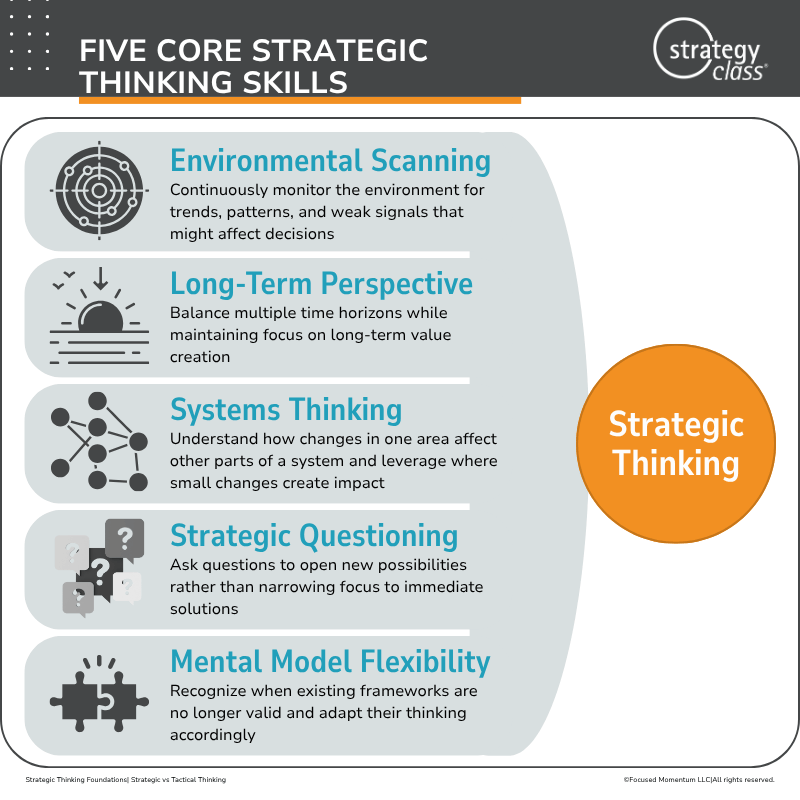
Let's examine each skill and how to build it.
SKILL 1: Environmental Scanning and Context Analysis
Strategic thinkers continuously monitor their environment for trends, patterns, and weak signals that might affect their decisions. This isn't about formal market research—it's about developing mental alertness to contextual shifts.
Key Capabilities:
- Trend Recognition: Identifying patterns across different domains and time periods
- Weak Signal Detection: Noticing early indicators of significant changes before they become obvious
- Cross-Industry Pattern Recognition: Applying insights from other sectors to your context
- Stakeholder Perspective Analysis: Understanding how different groups view the same situation
Development Practice:
Spend 15 minutes weekly scanning sources outside your industry.
Ask: "What's changing that might affect us?"
"What patterns am I seeing across different contexts?"
Proven Value: Organizations that utilize early warning systems and proactive problem-solving methods experience significant reductions in operational disruptions and enhanced crisis preparedness (Business Continuity Institute, 2024).
-
Applying Skill 1 to Our Small Business Case Study.
The neighborhood restaurant owner practices environmental scanning by:
- Monitoring local food trends on social media
- Attending community events to understand neighborhood changes
- Observing what local suppliers are developing
- Tracking when competitors open or close nearby
This scanning revealed that young families were moving into the neighborhood, creating an opportunity for family-friendly dining experiences that the chain wouldn't prioritize.
SKILL 2: Long-Term Perspective Development
Strategic thinking requires balancing multiple time horizons while maintaining focus on long-term value creation.
The Three-Layer Strategic View:
- Immediate (90 days): Execute current strategy effectively
- Strategic (1-3 years): Build capabilities for desired positioning
- Visionary (3+ years): Anticipate transformation and prepare for change
Development Practice:
For every major decision, ask:
"How does this position us for success in 2-3 years?"
"What capabilities does this build or constrain?"
-
Applying Skill 2 in a Nonprofit Setting.
A youth development nonprofit shifted from running multiple disconnected programs to creating a comprehensive pathway from early childhood through career development. This long-term perspective enabled them to:
- Attract larger foundation grants focused on systemic impact
- Develop corporate partnerships interested in workforce development
- Demonstrate measurable long-term outcomes on youth successThe strategic shift required investing in tracking systems and multi-year relationships rather than maximizing short-term program numbers.
SKILL 3: Systems Thinking and Connection Recognition
Strategic thinkers understand that everything is connected. They can see how changes in one area affect other parts of a system and identify leverage points where small changes create disproportionate impact.
Key Capabilities:
- Interdependency Analysis: Understanding how different elements influence each other
- Unintended Consequence Anticipation: Predicting secondary and tertiary effects
- Leverage Point Identification: Finding where small changes create big results
- Feedback Loop Recognition: Seeing how actions create reactions that influence future action
Development Practice:
When facing any challenge, map the connections:
"What else is affected by this?"
"Where might small changes create a significant impact?"
-
Applying Skill 3 to Team Leadership
A marketing team leader recognized that their organization was shifting toward data-driven decision-making. Rather than just executing current marketing campaigns, she thought strategically about the system:
- Connection: Marketing effectiveness → Data analysis capability → IT infrastructure → Team skills
- Leverage point: Training team members on data analysis tools would position them as strategic partners
- Unintended benefit: When digital transformation launched, her team was already preparedResult: The team moved from campaign executors to strategic partners in organizational decision-making.
SKILL 4: Strategic Questioning
Strategic thinkers ask fundamentally different questions than tactical problem-solvers. These questions open new possibilities rather than narrowing focus to immediate solutions.
The Strategic Questions Framework:
The Strategic Questions Framework is nine questions that activate strategic thinking patterns.
Expansion Questions (broaden perspective):
Expansion questions broaden your perspective beyond the immediate problem. They prevent you from optimizing the wrong solution. These questions force you to reconsider whether you're even solving the right challenge.
An example of an expansion question is: "What would success look like in 3 years?" This question expands your challenge time frame.
Connection Questions (reveal relationships):
Connection questions reveal hidden relationships and systemic factors. Strategic thinking addresses systems, not just components. These questions expose what you're missing because you're focused on obvious symptoms.
An example of a connection question is: "What else changes when this changes?" This question reveals and links implications you may not think through unless you stop to explore connections.
Innovation Questions (find new possibilities):
Innovation questions uncover breakthrough possibilities. They're deliberately provocative—pushing you to consider approaches you've been assuming are impossible. These questions turn constraints into creative catalysts.
An example of an innovation question is: "What would someone outside our industry do?" This question expands possibilities by seeking out inspiration from areas not typically referenced during problem-solving.
-
Applying Skill 4 to Innovation
When Airbnb founders faced initial struggles, they asked strategic questions:
- "What would success look like if, in three years, every city felt accessible to travelers the way it feels to the people who actually lidon't just need a place to sleep, but want to experience destinations like locals?" (Expansion)
This question expanded their time horizon and redefined what they were actually building toward: not a booking platform, but a way to experience cities as locals do.
- "What else changes when strangers trust each other enough to share homes?" (Connection)
This question revealed the systemic implications of their core challenge. Solving for trust didn't just fix a safety concern; it changed how guests experienced destinations, how hosts related to their neighborhoods, and what kind of company Airbnb needed to become.
- "What would someone from the design world (not the hotel industry) do to solve the problem of impersonal, expensive travel?" (Innovation)
Both founders were graduates of the Rhode Island School of Design. Asking what a designer, not a hotelier, would do led to solutions the hotel industry would never have considered: professional photography of listings, trust-building through design, and a platform experience centered on belonging rather than transactions.
These questions led to Airbnb's strategic positioning as an experience platform rather than an accommodation-booking service, a distinction that set it apart from every competitor in the space.
SKILL 5: Mental Model Flexibility
Strategic thinkers can recognize when their existing frameworks are no longer valid and adapt their thinking accordingly. This cognitive agility is crucial for navigating rapid change.
Key Capabilities:
- Assumption Questioning: Regularly examining beliefs underlying decisions
- Perspective Taking: Understanding how others view the same situation
- Framework Switching: Moving between different mental models as needed
- Paradox Navigation: Finding creative solutions that integrate apparent contradictions
Development Practice:
Regularly challenge your assumptions:
"What am I assuming to be true that might not be?"
"What evidence would change my mind?"
-
Applying Skill 5 to Our Neighborhood Restaurant Example
The restaurant owner had to challenge fundamental assumptions when the chain arrived:
- Old assumption: "People choose restaurants primarily based on food quality and price."
- Strategic reframing: "People choose restaurants based on the total experience and emotional connection."
- New mental model: "We're not in the food business—we're in the community-building business that happens to serve food."This mental model flexibility enabled differentiation strategies the chain couldn't copy.
STRATEGIC SKILL DEVELOPMENT SUMMARY
These five skills work together synergistically:
1. Environmental scanning provides raw inputs
2. Long-term perspective provides strategic direction
3. Systems thinking reveals connections and leverage points
4. Strategic questions unlock new possibilities
5. Mental model flexibility enables continuous adaptation
Implementation Reality: Managers trained in these strategic practices see 20-28% performance improvements, and their teams experience up to 18% higher engagement (Gallop, 2025).
Download for Free
Strategic Thinking Team Readiness Assessment
A clear way to check a team's strategic thinking strengths and pinpoint what's needed to improve.
Individual Strategic Thinking
Reed Hastings at Netflix
Reed Hastings demonstrated exceptional strategic thinking in transforming Netflix from DVD-by-mail to streaming dominance.
Environmental Scanning:
Hastings recognized that broadband internet adoption, declining bandwidth costs, and changing viewing habits would converge to make streaming viable—before these trends became obvious to competitors.
Long-Term Vision:
While others focused on optimizing DVD distribution, Hastings mentally modeled a future where physical media became obsolete. He invested in streaming capabilities even when they initially cannibalized profitable DVD revenues.
Systems Thinking:
Hastings understood that becoming a content creator (not just distributor) would be essential for long-term competitive advantage. Netflix's investment in original content seemed risky, but it positioned them to control their destiny as content costs rose.
Strategic Patience:
Hastings maintained focus on long-term positioning despite short-term criticism from investors who wanted immediate returns on streaming investments.
The Result of Individual Strategic Thinking: Netflix transformed from a DVD rental company into a global streaming platform that produces award-winning original content, fundamentally reshaping the entertainment industry.
Team Strategic Thinking
Apple's iPhone Development
Apple's iPhone team exemplified collective strategic thinking by integrating insights across multiple technologies and user behaviors to create an entirely new product category.
Cross-Domain Pattern Recognition:
The team connected trends in touch technology, mobile internet, digital photography, and music consumption to envision a unified device that would replace multiple gadgets.
User Experience Systems Thinking:
Rather than adding features to existing phones, they reimagined the entire mobile experience, integrating hardware, software, and ecosystem elements.
Strategic Timing:
The team understood that waiting for perfect technology would mean missing the market opportunity. They balanced technical constraints with market readiness.
Ecosystem Vision:
The iPhone was designed not as a standalone product but as the center of an integrated ecosystem of apps, services, and accessories.
The Result of Team Strategic Thinking: The iPhone created a new product category, transformed multiple industries (phones, cameras, music players, GPS devices), and established Apple's platform dominance.
Organizational Strategic Thinking
Amazon's Long-Term Approach
Amazon demonstrates how strategic thinking can become embedded in organizational culture.
Customer-Centric Systems Thinking:
Every decision is evaluated through the lens of long-term customer value, even when it conflicts with short-term profitability.
Strategic Investment Pattern:
Amazon consistently invests profits into capabilities that will create future advantages rather than maximizing current earnings. AWS, Prime, and logistics infrastructure all required years of strategic investment before profitability.
Market Creation vs. Market Share:
Rather than competing in existing markets, Amazon creates new markets through innovation (cloud computing, voice assistants, automated retail).
Strategic Optionality:
Amazon's diverse investments create multiple paths to future success rather than betting everything on a single strategy.
The Result of Organizational Strategic Thinking: Amazon has achieved dominant positions in multiple industries (e-commerce, cloud computing, logistics, and entertainment) through sustained strategic thinking and long-term investment discipline.
Small Business Strategic Thinking
The Neighborhood Restaurant
Returning to our restaurant example, the owner's strategic thinking created sustainable differentiation:
Strategic Positioning Choice:
Rather than competing on price and menu (tactical), the owner chose to compete on community connection and unique local experiences (strategic).
Implementation:
- Partnered with local farms and food producers, creating menu items unavailable at chains
- Hosted community events (local author readings, neighborhood meetings, live local music)
- Created a loyalty program for neighbors (15% discount for a modest fee)
- Organized "meet the producer" events connecting customers to local food suppliers
- Designed the space specifically for community gathering with flexible seating
Systems Thinking:
The owner recognized that the chain's advantages (scale, brand recognition, national promotions) created corresponding weaknesses (inability to be locally unique, corporate constraints, impersonal service).
Strategic Result for a Small Business:
Within two years:
- Customer loyalty exceeded pre-chain levels
- Average check size increased 25% despite not raising base prices
- Profit margins improved through premium positioning
- The restaurant became a neighborhood institution that the chain couldn't threaten
The chain eventually closed after three years, unable to compete on the strategic dimension of community connection.
Nonprofit Strategic Thinking
charity: water
This nonprofit organization revolutionized charitable giving through strategic thinking.
Strategic Problem Recognition:
Recognized that donor skepticism and lack of transparency were fundamental barriers to charitable giving, not just tactical fundraising challenges.
Innovation Through Constraints:
Developed a model where 100% of public donations go directly to water projects, with operational costs covered by separate funding sources.
Technology Integration:
Used GPS tracking and photos to show donors the exact projects they funded, creating unprecedented transparency.
Systems Impact:
This strategy increased transparency, built trust, significantly boosted donations, and influenced other nonprofits to improve accountability.
Strategic Result for a Nonprofit: charity: water has provided clean water to millions in developing countries while fundamentally changing donor expectations across the nonprofit sector.
CROSS-CUTTING STRATEGIC PATTERNS
These examples share common strategic thinking patterns:
1. Future-back thinking rather than present-forward extrapolation
2. System redesign rather than component optimization
3. Creating new categories rather than competing in existing ones
4. Long-term value focus despite short-term pressures
5. Turning constraints into advantages through creative reframing
Download our Free
Tactical Thinking Trap Assessment
Most leaders have one default pattern that keeps them stuck in reaction mode.
Your 90-Day Strategic Thinking Development Plan
Strategic thinking isn't an innate talent—it's a set of cognitive skills that can be developed through deliberate practice. The framework below outlines the requirements for systematic development across three phases. Each phase builds on the last, and progress is measurable at every stage.
PHASE I: Foundation Building (Days 1-30)
The core shift: Moving from reactive problem-solving to strategic questioning.
Phase I is about interrupting existing thinking patterns and replacing them with strategic habits. The primary work is learning to pause before responding, to ask different questions, and to begin scanning your environment for patterns rather than immediate solutions.
What changes by Day 30:
- You catch yourself asking, "What's the deeper pattern here?" before jumping to a fix
- You can identify the difference between a tactical response and a strategic one in real time
- You have begun noticing signals and trends outside your immediate focus
Key question driving this phase: What system or condition is creating the challenges I keep solving?
PHASE II: Skill Deepening (Days 31-60)
The core shift: From asking better questions to seeing systems and longer time horizons.
Phase II develops the analytical capabilities that make strategic questions productive. Systems thinking, long-term perspective, and pattern recognition across contexts are learnable skills, but they require structured practice applied to real challenges, not hypothetical ones.
What changes by Day 60:
- You can map the system around a significant challenge and identify leverage points
- Your decisions consistently consider 2–3 year implications without prompting
- You notice patterns others miss because you're scanning more broadly
Key question driving this phase: Where could a small change create a disproportionate strategic impact?
PHASE III: Advanced Application (Days 61-90)
The core shift: From applying frameworks to integrating them — and developing others.
Phase III is where strategic thinking becomes a capability rather than a practice. You begin testing assumptions systematically, adapting your mental models when evidence contradicts them, and bringing strategic thinking into how you lead your team — not just how you think personally.
What changes by Day 90:
- You regularly catch yourself saying, "I assumed X — what if Y is actually true?"
- Others seek your strategic perspective
- You can lead a conversation using strategic questions rather than providing answers
Key question driving this phase: What am I assuming to be true that I've never actually tested?
Beyond 90 Days: Continuous Development
Strategic thinking mastery requires ongoing practice. The leaders who develop lasting strategic advantage treat strategic thinking as a discipline, something they return to systematically rather than occasionally.
30-day check: Can you map systems and identify leverage points? Are your decisions creating strategic positioning?
60-day check: Are you asking fundamentally different questions? Do you notice patterns others miss?
90-day check: Has strategic thinking become more automatic? Are you seeing better results from your decisions?
.png?width=1366&height=768&name=Strategy%20Class%20CTAs%20(Website).png)
MYTH 1: "Strategic thinking is only for senior executives."
The Misconception:
Strategic thinking is a C-suite responsibility. Everyone else should focus on execution.
The Reality:
Strategic thinking enhances effectiveness at every organizational level, not just in the corner office.
Why This Myth Persists:
Traditional business structures concentrated strategic decisions at the top. However, in today's fast-changing environment, organizations need strategic thinking capabilities distributed throughout all levels.
Real-World Example:
At Toyota, assembly line workers are trained to think strategically about quality and process improvement. When front-line employees can think strategically about their work's impact on the entire system, organizations become more resilient and adaptive.
This distributed strategic thinking contributed to Toyota's legendary reputation for reliability and continuous improvement.
The Evidence:
- 70% of team engagement is determined by the manager (Gallup, 2025)
- Managers trained in strategic practices see 20-28% performance improvements (Gallup, 2025)
- Their teams experience up to 18% higher engagement (Gallup, 2025)
The Truth:
Whether you're leading a team of five or a division of 500, strategic thinking skills improve decision-making quality and career advancement prospects.
MYTH 2: "You Need Complete Information to Think Strategically"
The Misconception:
Strategic thinking requires comprehensive data and perfect information before making decisions.
The Reality:
Strategic thinking thrives in uncertainty and helps you make better decisions with incomplete information.
Why This Myth Persists:
Many professionals avoid strategic thinking because they believe they need complete data before making strategic decisions. This perfectionist trap prevents strategic action when timely decisions matter most.
Real-World Example:
When Amazon launched AWS, it didn't have complete market research about cloud computing demand. Jeff Bezos and his team thought strategically about:
- Technology trends and infrastructure evolution
- Internal capabilities they had developed
- Potential market needs they could anticipate
They launched with limited information but strong strategic reasoning. Waiting for complete information would have meant missing the market opportunity entirely.
The Truth:
Strategic thinking provides frameworks for navigating uncertainty, not eliminating it. The goal is making informed strategic bets, not achieving certainty before acting.
MYTH 3: "Strategic Thinking Takes Too Much Time"
The Misconception:
"I don't have time for strategic thinking—I'm too busy putting out fires."
The Reality:
Strategic thinking saves time by preventing problems and focusing effort on high-impact activities.
The Time Investment Paradox:
Tactical Approach:
- Spend 2 hours weekly solving recurring problems
- Annual cost: 104 hours repeatedly solving the same issues
- Result: Problems keep recurring
Strategic Approach:
- Spend 30 minutes weekly on strategic thinking
- Plus 4 hours designing systemic solutions
- Annual investment: 30 hours + permanent problem elimination
- Result: Problems stop recurring
Real-World Example:
A nonprofit executive director was working 60-hour weeks, managing crises. After implementing strategic thinking practices:
- Week 1: Identified that 80% of "urgent" problems followed predictable patterns
- Week 2: Created systems to prevent the top 3 recurring issues
- Week 3: Working 45-hour weeks with better organizational results
The Truth:
Strategic thinking is a time investment that pays compounding returns by eliminating repetitive problems and focusing energy on high-value activities..
MYTH 4: "Strategic Planning and Strategic Thinking are the Same"
The Misconception:
Annual strategic planning sessions develop strategic thinking skills.
The Reality:
Strategic planning is a process; strategic thinking is a cognitive capability.
Key Differences:
Strategic Planning: Annual or periodic process | Creates plans and documents | Focuses on resource allocation | Led by senior management | Structured and formal
Strategic Thinking: Continuous cognitive practice | Develops mental frameworks | Focuses on pattern recognition | Valuable at all levels | Flexible and adaptive
Why This Matters:
Organizations often believe strategic planning sessions develop strategic thinking. Strategic planning creates documents and processes. Strategic thinking develops mental frameworks for approaching complex challenges.
The Truth:
Strategic planning works best when participants already possess strategic thinking capabilities. Strategic thinking provides the cognitive foundation that makes strategic planning processes more effective.
MYTH 5: "Strategic Thinking is Just 'Thinking Bigger'"
The Misconception:
Strategic thinking means having grander visions or thinking more ambitiously.
The Reality:
Strategic thinking involves specific cognitive skills and learnable frameworks, not just expansive thinking.
What Strategic Thinking Actually Involves:
- Pattern recognition across different contexts and time periods
- System analysis to understand interconnections and leverage points
- Scenario development to prepare for multiple possible futures
- Assumption testing to challenge mental models and cognitive biases
- Stakeholder analysis to understand different perspectives and interests
Why "Think Bigger" Advice Fails:
It sounds inspiring, but provides no actionable guidance. Strategic thinking requires concrete skills like environmental scanning, systems mapping, and strategic questioning—not just broader ambitions.
Small Business Example:
The neighborhood restaurant owner didn't just "think bigger" about competing with a chain. They developed specific strategic thinking skills:
- Environmental scanning to understand community trends
- Systems thinking to map the chain's strengths and weaknesses
- Strategic questioning to identify differentiating opportunities
- Long-term perspective to build sustainable advantages
The Truth:
Strategic thinking is a set of specific, learnable cognitive skills, not just an inspirational mindset shift.
MYTH 6: "Strategic Thinking is Too Complex for Small Businesses
The Misconception:
Strategic thinking requires large-scale resources or complex analytical departments that small businesses can't afford.
The Reality:
Small businesses benefit more from strategic thinking because resource constraints make every decision more impactful.
Why Small Businesses Need Strategic Thinking:
- Limited resources mean poor decisions are more costly
- Market positioning matters more than operational scale
- Strategic advantages matter more when you can't compete on size
- Agility enables faster strategic pivots than large competitors
Real-World Example:
The small asset management firm (from our earlier example) struggled with growth in its first few years. After developing strategic thinking capabilities, they realized serving both high-net-worth individuals and nonprofits diluted their limited resources.
Strategic Decision:
Stop serving high-net-worth individuals and focus exclusively on their core nonprofit market.
Short-term Impact:
Assets Under Management decreased as they transitioned clients to other firms.
Strategic Result:
- Year 1: 30% AUM growth with more profitable, easier-to-manage clients
- Year 2: 50% growth rate as strategic positioning attracted ideal clients
- Built a reputation as THE nonprofit asset management specialist
The Truth:
Small businesses and nonprofits benefit most from strategic thinking because every decision matters more, every resource must create maximum value, and strategic positioning often matters more than operational scale.
CRITICAL INSIGHT: Research shows that 40% of small businesses make it to their 10-year mark (SBA). The pattern among those that make it consistently points to one capability: the ability to make strategic decisions about positioning, resources, and focus rather than competing purely on operational execution."
MOVING BEYOND MYTHS TO MASTERY
These myths create unnecessary barriers to the development of strategic thinking.
The reality is that strategic thinking:
- Works at every level from individual contributors to CEOs
- Thrives in uncertainty rather than requiring perfect information
- Saves time by preventing problems rather than consuming time
- Differs from planning as a cognitive skill rather than an organizational process
- Requires specific skills rather than just ambitious thinking
- Benefits small organizations most because decisions have a greater impact
Strategic Thinking Quick Start Guide
Begin developing these essential capabilities immediately!
Strategic Thinking for Your Specific Context
Strategic thinking principles are universal, but their application varies significantly across different organizational contexts, roles, and industries. Understanding how to adapt strategic thinking to your specific situation increases its practical value and effectiveness.
Detailed Implementation Guides by Context
Click any section below to jump to detailed guidance, real-world examples, and specific tools.
Strategic Thinking for Small Business Owners
Small business owners face unique strategic thinking challenges that differ from those of corporate executives or nonprofit leaders. Resource constraints, market positioning decisions, and growth choices require specialized strategic thinking applications.
Key Strategic Thinking Applications
Market Positioning Strategy
Small businesses can't compete on everything, so strategic thinking helps identify winnable market positions. Instead of asking "How do we compete with larger companies?" strategic thinking reframes this as "What unique value can we provide that larger companies can't or won't?"
Resource Allocation Decisions
Limited resources make every strategic investment crucial. Strategic thinking helps evaluate opportunities through long-term value creation rather than immediate revenue generation. For example, investing in customer experience systems may reduce short-term profits but create sustainable competitive advantages unattainable without this investment.
Growth Strategy Development
Strategic thinking helps distinguish between healthy growth and growth that compromises strategic position. Rather than pursuing every opportunity, strategic thinkers ask: "Does this opportunity strengthen our core capabilities and market position?".
Real-World Example: Small Asset Management Firm
The founders of a small asset management firm struggled to sustain growth in their first few years. After developing strategic thinking models to document their strategic reasoning, they realized that serving high-net-worth individuals as well as their core market (nonprofit organizations) was diluting their strategic position.
The Strategic Decision:
Stop serving high-net-worth individuals (which could be served by many firms) and focus exclusively on their founding vision of serving nonprofits.
Short-term Impact:
By transitioning high-net-worth clients to other firms, they initially reduced Assets Under Management—a tough decision for any organization, but especially for a small business.
Strategic Result:
- Year 1: 30% AUM growth with more profitable, easier-to-manage clients
- Year 2: 50% growth rate as strategic positioning attracted ideal clients
- Long-term: Built reputation as the nonprofit asset management specialist
This strategic approach demonstrates that small businesses implement strategic thinking better than larger entities because they can act quickly. Within months, this firm not only saw substantial growth but also attracted clients aligned with their core expertise.
Research Support:
Strategic thinking is backed by data—87% of executives believe innovation is essential to organizational success and growth, yet innovation capabilities were consistently among the top three growth levers across industries (McKinsey, 2025).
-
Implementation Tip
Start with weekly environmental scanning (15 min) before investing in complex strategic frameworks.
Monitor: local market changes, competitor moves, and customer behavior shifts.
Strategic Thinking for Entrepreneurs and Startups
Entrepreneurial strategic thinking requires balancing speed and experimentation with long-term vision and market positioning. Entrepreneurs must think strategically about market opportunities, competitive positioning, and scalable business model development.
Key Strategic Thinking Applications
Market Opportunity Assessment
Strategic thinking helps entrepreneurs evaluate market opportunities beyond immediate revenue potential. Instead of asking "Can we build this?" strategic thinkers ask "Should we build this?" and "What market position does this create?"
The most successful entrepreneurs don't just identify gaps—they think strategically about whether those gaps represent sustainable opportunities or temporary arbitrage situations.
Product Development Strategy
Strategic thinking prevents feature creep and maintains focus on core value proposition. Rather than adding every feature customers request, strategic entrepreneurs think about the underlying jobs customers are trying to accomplish.
This approach led to breakthrough products like the iPhone, which succeeded not by having the most features but by rethinking what a phone should be fundamentally.
Scaling Strategy
Strategic thinking helps entrepreneurs anticipate potential challenges as they grow and build systems that scale effectively. This prevents the common pattern of rapid growth followed by operational chaos.
Successful entrepreneurs think strategically about the difference between what got them to their current scale and what will enable the next order of magnitude growth.
Real-World Example: Airbnb's Strategic Positioning
When Brian Chesky and his co-founders started Airbnb, they thought strategically about the sharing economy before it existed. Instead of just creating a room rental service, they envisioned a platform that would transform how people travel and experience destinations.
Strategic Thinking Patterns:
Beyond the Obvious Problem:
Tactical thinking: "How do we help people rent spare rooms?"
Strategic thinking: "What if travelers don't just need accommodation—they want to experience destinations like locals?"
Systems Perspective:
- Recognized that trust between strangers was the fundamental barrier
- Built entire systems (reviews, verification, insurance) around enabling trust
- Created network effects where each successful transaction made the platform more valuable
Long-term Vision:
- Positioned as an experience platform rather than an accommodation booking
- Built features and partnerships that created sustainable advantages
- Established market leadership before traditional hospitality companies understood the threat
This strategic thinking approach helped them build features and partnerships that created network effects and sustainable competitive advantages that traditional hotels couldn't replicate.
-
Implementation Tip
Use the "10x test" monthly.: What would have to be true to grow 10x? This reveals which aspects of your business model will break at scale.
Strategic Thinking for Corporate Team Leaders
Team leaders in corporate environments face strategic thinking challenges around resource allocation, stakeholder management, and career development while contributing to broader organizational strategies.
Key Strategic Thinking Applications
Team Capability Development
Strategic thinking helps team leaders build capabilities that serve both immediate project needs and long-term organizational strategy. Instead of just meeting current targets, strategic team leaders ask: "What capabilities should we develop to position our team for future success?"
This forward-thinking approach creates teams that become strategic assets rather than just execution units.
Cross-Functional Collaboration
Strategic thinking enables team leaders to understand how their work connects to other departments and organizational priorities. This systems perspective improves collaboration and resource allocation decisions.
Leaders who think strategically about cross-functional relationships build alliances that amplify their team's impact and create opportunities for advancement.
Career and Succession Planning
Strategic thinking helps team leaders develop themselves and their team members for advancement opportunities while maintaining current performance standards.
The best team leaders think strategically about creating a "bench" of talent that enables their own upward mobility while ensuring team continuity.
Real-World Example: Marketing Team Strategic Positioning
A marketing team leader at a technology company recognized that her organization was shifting toward data-driven decision-making. Instead of just executing current marketing campaigns, she thought strategically about the future.
Strategic Thinking Process:
Environmental Scanning:
- Noticed increasing executive emphasis on metrics and ROI
- Observed IT investments in analytics infrastructure
- Recognized competitors building data science teams
Future-Back Thinking:
- Envisioned her team as strategic partners in business decisions
- Identified data analysis as a critical future capability
- Anticipated digital transformation before it was announced
Strategic Investment:
- Invested time training team members on data analysis tools
- Worked with IT to improve marketing analytics systems
- Built relationships with data teams in other departments
- Documented how data insights informed campaign decisions
Strategic Result:
When the organization launched a major digital transformation initiative two years later:
- Her team was positioned as strategic partners rather than campaign implementers
- Three team members were promoted to cross-functional leadership roles
- The team received an increased budget based on demonstrated strategic value
- She was promoted to the VP level based on her strategic capability development
-
Implementation Tip
Create a "strategic capability map" showing which team skills serve current projects vs. future organizational needs.
Invest 20% of development time in future-focused capabilities.
Strategic Thinking for Nonprofit Organizations
Nonprofit strategic thinking requires balancing mission impact with organizational sustainability while managing diverse stakeholder expectations and resource constraints.
Key Strategic Thinking Applications
Mission Impact Strategy
Strategic thinking helps nonprofit leaders distinguish between activity and impact. Instead of asking "How many people did we serve?" strategic thinkers ask "What systemic change are we creating?" and "How do we maximize lasting impact?"
This reframing shifts focus from outputs (number of programs delivered) to outcomes (actual change created in people's lives or communities).
Funding Strategy Development
Strategic thinking enables nonprofit leaders to develop diversified funding approaches that support long-term sustainability rather than just meeting immediate budget needs.
The most sustainable nonprofits think strategically about funding portfolios that balance restricted grants with unrestricted support, individual giving with institutional funding, and earned revenue with contributed income.
Partnership and Collaboration Strategy
Strategic thinking helps nonprofit leaders identify partnerships that amplify impact rather than just sharing resources. This includes thinking about collective impact initiatives and strategic alliances.
Effective nonprofit strategic thinkers ask: "How can we multiply our impact through others?" rather than "How can we do everything ourselves?"
Real-World Example: Youth Development Nonprofit Transformation
A youth development nonprofit was struggling with funding stability and program effectiveness. They ran multiple disconnected programs—mentoring, tutoring, job training—but couldn't demonstrate clear impact or attract major foundation support.
Strategic Thinking Process:
Pattern Recognition:
- Noticed that successful alumni had participated in multiple programs
- Recognized that isolated interventions produced limited results
- Identified that foundations prioritized comprehensive approaches
Strategic Reframing:
- Old framing: "We run several youth programs"
- Strategic framing: "We create comprehensive pathways from early childhood through career success"
Strategic Repositioning:
- Redesigned programs as an interconnected pathway rather than separate services
- Developed a theory of change showing how stages build on each other
- Created measurement systems tracking youth progress across multiple years
- Built partnerships to fill gaps they couldn't serve directly
Strategic Result:
Within three years:
- Attracted $2M foundation grant for pathway model implementation
- Developed corporate partnerships interested in workforce development outcomes
- Demonstrated 65% college completion rate for pathway participants (vs. 30% for comparison group)
- Became a model program studied by other youth development organizations
-
Achieved financial sustainability through diversified funding
Research Support:
Organizations with both highly aligned business & innovation strategies and pro-innovation culture have 30% higher growth in enterprise value (Viima Research, 2023).
-
Implementation Tip
Develop your "theory of change" as a strategic thinking tool.
Map how your activities connect to long-term systemic change. Use this framework to evaluate all programs and partnership decisions.
Strategic Thinking for Board Members
Board members require strategic thinking skills to provide effective governance and oversight while supporting management without micromanaging operations.
Key Strategic Thinking Applications
Governance Strategy
Strategic thinking helps board members focus on their unique value contribution rather than duplicating management functions. This includes thinking strategically about risk oversight, strategic planning support, and succession planning.
Effective board members ask: "What perspective can we provide that management cannot see from inside the organization?"
Industry and Market Analysis
Strategic thinking enables board members to provide external perspective and industry insights that complement management's operational focus.
Board members with strategic thinking capabilities help organizations anticipate industry disruptions, identify emerging opportunities, and navigate competitive threats before they become crises.
Organizational Development Strategy
Strategic thinking helps board members support organizational capacity building and leadership development initiatives that strengthen long-term effectiveness.
Strategic board members invest attention in:
- Ensuring leadership succession pipelines
- Building organizational capabilities for future challenges
- Strengthening governance structures as organizations grow
-
Implementation Tip
As a board member, your strategic value comes from an external perspective. Spend 60% of meeting time on strategic questions and only 40% on operational review. Ask, "What should we be worried about that we're not discovering?"
CROSS-CUTTING INSIGHTS: UNIVERSAL STRATEGIC PATTERNS
Regardless of your specific context, effective strategic thinking shares common patterns:
- Future-back thinking rather than present-forward extrapolation
- System redesign rather than component optimization
- Creating new categories rather than competing in existing ones
- Long-term value focus despite short-term pressures
-
Turning constraints into advantages through creative reframing
The strategic advantage is measurable: companies with innovation cultures are 3.5 times more likely to outperform peers (McKinsey, 2022), while organizations implementing strategic transformations improve operational performance by 30-50% (McKinsey, 2020).
Download our Free
Tactical Thinking Trap Assessment
Most leaders have one default pattern that keeps them stuck in reaction mode.
Scenario Planning and Strategic Futures
Scenario planning is a systematic approach to thinking about multiple possible futures and developing strategic responses for each scenario. Unlike forecasting (which attempts to predict the future), scenario planning prepares you for several plausible futures.
The Four-Scenario Framework:
.png?width=800&height=800&name=Four-Scenario%20Framework%20(800%20x%20800%20px).png)
Scenario Planning Process:
- Identify key uncertainties affecting your context (technology changes, market evolution, regulatory shifts)
- Develop 3-4 distinct scenarios based on different combinations of these uncertainties
- Assess the strategic implications of each scenario for your organization or role
- Identify strategic actions that work well across multiple scenarios
- Monitor leading indicators, suggesting which scenario is emerging
Real-World Application:
A software company executive used scenario planning to prepare for AI integration:
Scenario 1: Gradual AI Adoption
- AI tools slowly integrate into workflows over 3-5 years
- Minimal disruption to the current business model
- Response: Steady capability building
Scenario 2: AI Acceleration
- Rapid advancement forces quick adaptation within 12-18 months
- Creates competitive pressure for early adopters
- Response: Aggressive investment in AI capabilities
Scenario 3: AI Plateau
- Current AI capabilities hit limitations
- Creates opportunities for human-AI collaboration approaches
- Response: Focus on complementary human skills
Scenario 4: AI Transformation
- Breakthrough capabilities fundamentally change software development, sales, and support
- Complete industry restructuring
- Response: Business model reinvention
Strategic Assumption Testing
Strategic decisions are based on assumptions about customer behavior, competitive responses, market evolution, and organizational capabilities. Strategic assumption testing systematically examines these underlying beliefs to improve decision quality.
The Assumption Testing Framework
STEP 1: Assumption Identification
List key assumptions underlying your strategic decisions:
- Market assumptions: Customer needs, market size, growth rates
- Competitive assumptions: Competitor responses, new entrants, substitutes
- Capability assumptions: Your organization's strengths, resources, limitations
- Environmental assumptions: Regulatory changes, technology evolution, economic trends
STEP 2: Assumption Prioritization
- Impact: How much would your strategy change if this assumption were wrong?
- Uncertainty: How confident are you that this assumption is accurate?
- Testability: How easily can you gather evidence about this assumption?
STEP 3: Evidence Gathering
Strategic thinking helps entrepreneurs or high-priority assumptions:
- Supporting evidence: What data or experience supports this assumption?
- Contradicting evidence: What evidence challenges this assumption?
- Missing evidence: What information would help validate or refute this assumption?
STEP 4: Strategic Implications
- If the assumption is correct, how does this strengthen your strategic approach?
- If the assumption is wrong, how would this change your strategic direction?
- Uncertainty management: How can you design flexibility into your strategy?
A Practical Example:
A software company assumed customers would pay premium prices for advanced features.
Assumption Testing Revealed:
- Supporting evidence: Customer surveys indicated interest in advanced capabilities
- Contradicting evidence: Usage data showed most customers used basic features only
- Missing evidence: Willingness to pay data through pricing experiments
Strategic Implication:
Shift from premium feature strategy to ease-of-use and value pricing strategy, fundamentally changing product development priorities.
Competitive Intelligence for Strategic Thinking
Strategic competitive intelligence focuses on understanding competitor strategic intentions and capabilities rather than just current actions.
Strategic Competitive Analysis Framework:
Competitor Strategic Positioning Analysis
- Value proposition: What unique value do competitors claim to provide?
- Target markets: Which customer segments are they prioritizing?
- Capability investments: Where are they building new capabilities?
- Partnership strategies: How are they extending capabilities through alliances?
Competitor Strategic Behavior Patterns
- Innovation approach: How do they develop and launch new offerings?
- Market entry strategy: How do they approach new markets or customer segments?
- Resource allocation: Where do they invest time, money, and attention?
- Risk tolerance: How aggressive or conservative are their strategic moves?
Strategic Gap Analysis
- Unserved markets: What customer needs are competitors ignoring?
- Capability gaps: What capabilities do competitors lack that create opportunities?
- Strategic blind spots: What assumptions might competitors hold that create vulnerabilities?
Real-World Application:
A consulting firm analyzed competitor strategies and discovered most firms focused on large corporate clients while ignoring mid-market companies.
Strategic Response:
Repositioned around mid-market expertise, creating a differentiated market position with less direct competition.
Result:
40% revenue growth over two years by dominating an underserved market segment.
Innovation Thinking Patterns
Strategic innovation thinking goes beyond incremental improvements to envision breakthrough possibilities.
PATTERN 1: Constraint Elimination Thinking
Process:
- Identify constraints everyone accepts as unchangeable
- Ask: "What if this constraint didn't exist?"
- Design solutions for a constraint-free world, then work backward to practical implementation
Example:
Netflix eliminated the constraint of physical media distribution, enabling global content delivery and original content production strategies that were impossible for traditional video rental companies.
PATTERN 2: Substitution and Replacement Thinking
Process:
- Identify what your offering replaces or substitutes
- Ask: "What if customers didn't need what we're replacing?"
- Look for opportunities to eliminate the underlying need
Example:
Uber didn't just create a better taxi service; they eliminated the need to own a car for transportation, opening new market opportunities in urban mobility.
PATTERN 3: Aggregation and Disaggregation Thinking
Process:
- Examine how value is currently bundled or separated
- Ask: "What if we bundled/unbundled differently?"
- Find new ways to combine or separate services, creating more value
Example:
Amazon Web Services disaggregated technology infrastructure, allowing companies to purchase computing, storage, and networking capabilities separately rather than building entire IT departments.
Innovation Thinking Practice:
- Weekly innovation questions:
- Apply one innovation thinking pattern to a current challenge
- Cross-industry inspiration:
- Study how other industries approach similar challenges
- Customer needs analysis:
- Understand broader needs customers are trying to accomplish beyond your current offering
MASTERING ADVANCED TECHNIQUES
These advanced techniques require:
- Strong foundation in basic strategic thinking skills
- Systematic practice rather than occasional application
- Collaborative exploration with diverse perspectives
- Continuous refinement based on results and learning
Organizations that master these techniques achieve:
- Better strategic decisions through assumption testing and scenario planning
- Competitive advantages through strategic intelligence and innovative thinking
- Greater resilience by preparing
Performance Impact: Companies actively promoting innovation culture are 3.5 times more likely to outperform their peers (McKinsey, 2022)
FAILURE PATTERN 1: Mental Model Rigidity
The Blockbuster Case
What Happened?
Blockbuster's leadership couldn't adapt its mental model of video rental as a location-based, physical inventory business even when market conditions changed dramatically.
Strategic Thinking Breakdown:
Environmental Scanning Failure:
Saw Netflix as a niche player rather than recognizing the strategic implications of their different business model.
Systems Thinking Limitation:
Couldn't conceive how streaming technology, broadband adoption, and changing consumer preferences would converge to disrupt their industry.
Assumption Protection:
Defended existing assumptions about customer behavior rather than testing them against new evidence.
Strategic Questioning Absence:
Asked "How do we optimize our current model?" instead of "What if our current model becomes obsolete?"
The Numbers:
- 2000: Netflix proposed a partnership, but Blockbuster declined
- 2004: Blockbuster was worth $5 billion
- 2010: Blockbuster filed for bankruptcy
- 2013: Blockbuster's corporate stores close, leaving a single franchised location in Bend, Oregon
Prevention Strategies:
- Regular assumption audits:
- Quarterly examination of strategic assumptions with explicit evidence review
- Devil's advocate processes:
- Assign team members to argue against prevailing strategic assumptions
- Cross-industry learning:
- Study how other industries have been disrupted to identify pattern recognition
- Strategic scenario planning:
- Regularly consider scenarios where current business models become inadequate
Application to Your Context:
- What assumptions about your industry or market do you never question?
- How might you create processes to challenge your own strategic assumptions?
- What would happen to your strategy if your core assumptions proved incorrect?
FAILURE PATTERN 2: Environmental Scanning Blindness
The Kodak Case
What Happened?
Kodak invented digital camera technology in 1975, but failed to recognize its strategic implications for its film-based business model.
Strategic Thinking Breakdown:
Signal Misinterpretation:
Viewed digital photography as inferior technology rather than recognizing its improvement trajectory.
Market Analysis Limitation:
Focused on current customer preferences rather than understanding how preferences might evolve.
Competitive Myopia:
Underestimated how technology companies would enter the photography market.
Systems Thinking Failure:
Couldn't see how digital photography would transform the entire photography ecosystem (cameras, printing, sharing, storage).
The Numbers:
- 1975: Kodak invented the digital camera
- 1990s: Kodak earned 70% of its profits from film
- 2012: Kodak filed for bankruptcy
- Peak market cap: $31 billion (1997) → $140 million (2012)
Prevention Strategies:
- Weak signal monitoring:
- Systematic attention to emerging technologies and trends that seem insignificant today
- Technology trajectory analysis:
- Understand improvement curves for emerging technologies even when current performance is inadequate
- Adjacent industry scanning:
- Monitor developments in related industries that might affect your market
- Customer evolution thinking:
- Consider how customer needs and preferences might change rather than just current requirements
Application to Your Context:
- What emerging trends in your environment do you dismiss as insignificant?
- How might you improve your environmental scanning to detect strategic changes earlier?
- What adjacent industries might produce competitors or technologies that affect your market?
FAILURE PATTERN 3: Short-Term Optimization Trap
What Happens?
Organizations sacrifice long-term strategic positioning to meet short-term financial targets, gradually eroding competitive advantages.
Strategic Thinking Breakdown:
Time Horizon Confusion:
Treating strategic decisions as if they were operational decisions.
Metrics Misalignment:
Measuring success through short-term indicators rather than strategic progress.
Pressure Responsiveness:
Reacting to immediate stakeholder pressures rather than maintaining strategic direction.
Investment Trade-offs:
Choosing immediate cost savings over capability building.
Real-World Contrasting Example:
Amazon's consistent reinvestment of profits into long-term capabilities despite investor pressure for higher short-term returns.
Amazon's Strategic Approach:
- Prioritized long-term customer value over quarterly earnings
- Invested billions in AWS, Prime, logistics infrastructure before profitability
- Maintained strategic direction despite analyst criticism
Result:
Market leadership in multiple categories (e-commerce, cloud computing, logistics, and entertainment).
Prevention Strategies:
- Strategic investment protection:
- Reserve resources for strategic initiatives that won't be cut during pressure periods
- Long-term metrics development:
- Create measurement systems tracking strategic progress alongside operational performance
- Stakeholder education:
- Help stakeholders understand how short-term sacrifices damage long-term value creation
- Strategic patience discipline:
- Maintain strategic direction despite short-term pressures
FAILURE PATTERN 4: Strategic Consensus Paralysis
What Happens?
Organizations become paralyzed by attempts to achieve consensus on strategic direction, missing opportunities while competitors act decisively.
Strategic Thinking Breakdown:
Decision-Making Confusion:
Treating strategic thinking as a democratic process rather than an analytical discipline.
Risk Aversion:
Avoiding strategic decisions because they involve uncertainty.
Information Perfectionism:
Waiting for complete information before making strategic moves.
Stakeholder Accommodation:
Trying to satisfy all stakeholders rather than making strategic trade-offs.
Prevention Strategies:
- Strategic decision frameworks:
- Clear processes for when and how strategic decisions get made
- Acceptable risk tolerance:
- Explicit agreements about acceptable levels of strategic uncertainty
- Strategic trade-off acknowledgment:
- Recognition that strategic choices inherently involve saying "no" to some opportunities
- Action bias development:
- Cultural encouragement of strategic experimentation and learning
Application to Your Context:
- How does your organization or team make strategic decisions?
- What prevents you from acting on strategic insights?
- How might you balance stakeholder input with strategic decision-making speed?
GENERAL PREVENTION FRAMEWORK:
BUILDING STRATEGIC THINKING RESILIENCE
Quarterly Strategic Health Checks:
- Assumption review: What strategic assumptions need testing or updating?
- Environmental scanning: What signals might we be missing or misinterpreting?
- Time horizon balance: Are we maintaining an appropriate balance between short-term and long-term thinking?
- Decision-making assessment: How effective are our strategic decision-making processes?
Semi-Annual Strategic Thinking Audits:
- Pattern recognition: What patterns from other industries or contexts might apply to our situation?
- Mental model examination: How might our current mental models be limiting our strategic options?
- Competitive intelligence: What are we learning about competitor strategic directions and capabilities?
- Innovation opportunity assessment: What breakthrough possibilities might we be overlooking?
Annual Strategic Thinking Capability Development:
- Skill gap analysis: What strategic thinking capabilities do we need to strengthen?
- Learning integration: How can we incorporate strategic thinking lessons from successes and failures?
- Framework evolution: How should we update our strategic thinking approaches based on experience?
Critical Lesson: Strategic thinking failures often result from cognitive limitations rather than resource constraints or market conditions. Organizations with more resources and market position can still fail strategically if their leadership cannot think beyond established mental models.
.png?width=1080&height=1080&name=Instagram%20post%20(1).png)
Strategic Thinking as Your Competitive Advantage
Strategic thinking has evolved from a useful business skill to an essential cognitive capability for thriving in the 21st century. The ability to see patterns, anticipate consequences, think systemically, and maintain a long-term perspective while managing immediate pressures now determines leadership effectiveness across all contexts.
The Strategic Thinking Performance Gap
The data reveals a critical opportunity:
- Only 28% of executives rate their strategic decisions as high-quality (McKinsey/Harvard Business School, 2025)
- Organizations implementing strategic thinking capabilities improve operational performance by 30-50% (McKinsey, 2020)
- Companies with innovation cultures are 3.5 times more likely to outperform peers (McKinsey, 2022)
- Strategic thinking training produces 20-28% performance improvements (Gallup, 2025)
Strategic Thinking Across All Contexts
Strategic thinking principles apply universally:
For Small Business Owners:
- Create a unique value that larger competitors can't replicate
- Build sustainable competitive advantages with limited resources
- Position strategically rather than compete operationally
For Entrepreneurs:
- Recognize breakthrough opportunities before they become obvious
- Build scalable business models with strategic foundations
- Create market categories rather than compete in existing ones
For Corporate Leaders:
- Develop team capabilities serving long-term organizational strategy
- Navigate complex stakeholder environments effectively
- Prepare for advancement through a strategic perspective
For Nonprofit Executives:
- Maximize mission impact with constrained resources
- Build sustainable funding through strategic positioning
- Create systemic change rather than just direct service
The Path to Strategic Thinking Mastery
Developing strategic thinking requires:
- Cognitive transformation from reactive problem-solving to proactive opportunity creation
- Skill development in environmental scanning, systems thinking, and strategic questioning
- Consistent practice applying strategic thinking patterns to everyday challenges
- Mental model flexibility, adapting frameworks as circumstances change
- Long-term commitment to continuous strategic thinking development
From Tactical Manager to Strategic Leader
The leaders who will succeed in the coming decade won't just be those who can solve problems—they'll be those who can think strategically about shaping their future in an uncertain world.
Strategic thinking enables you to:
- Move from reactive firefighting to proactive strategic positioning
- Transform from tactical efficiency to strategic effectiveness
- Shift from problem-solving to opportunity creation
- Evolve from managing constraints to creating competitive advantages
YOUR STRATEGIC THINKING JOURNEY STARTS NOW
Whether you're leading a Fortune 500 company, a growing startup, a nonprofit organization, or your own professional development, strategic thinking provides the cognitive foundation for sustained success.
The frameworks, patterns, and practices outlined in this guide offer a starting point for developing these essential capabilities. The question isn't whether you need strategic thinking skills—it's how quickly you can develop them and how systematically you can apply them.
The Strategic Imperative: In an environment where only 28% of executives make high-quality strategic decisions, developing superior strategic thinking capabilities creates immediate competitive advantage.
Ready to Master Strategic Thinking?
-
1. Start with Immediate Application
Download the Strategic Thinking Quick Start Guide
- 3 strategic thinking patterns for immediate use
- Strategic question frameworks
- Role-specific applications for your exact context
-
2. Learn new thinking patterns
Get your Tactical Thinking Trap Assessment
- 8 Questions
- 4 Common Thinking Trap Patterns
- 6 Dominant profiles
- 6 Recommendations
-
3. Master Strategic Thinking Systematically
Explore Strategic Thinking Foundations
An integrated system to consistently make the strategic mindset shift:
-
4-part challenge discovery process to define your strategic challenge
-
A set of 9 strategic questions that transform any challenge into breakthrough insights
-
6-step strategic response planning framework
-
2-part stakeholder mapping practice to successfully enroll those critical to your response plan
-
The Choice Is Yours
You can continue with reactive, tactical approaches—solving the same problems repeatedly, responding to changes after they become obvious, and wondering why strategic success remains elusive.
Or you can develop systematic strategic thinking capabilities that enable you to:
- Anticipate changes and prepare for multiple futures
- Identify opportunities others miss
- Create sustainable competitive advantages
- Navigate complexity with confidence
- Lead strategically rather than just manage tactically
The frameworks are here.
The research validates their impact. The only question is: when will you start?
Begin your strategic thinking journey with the Quick Start Guide →
Begin your team's journey with a Discovery Call →